
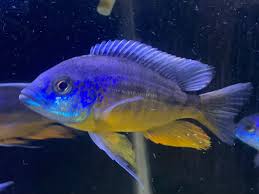
TANZANIAN SPILONTUS – male
$80.00
Full Description
tanzanian spilonotus care guide
scientific name: Protomelas spilonotus
general overview
-
A moderately peaceful malawi peacock-type cichlid that shows good color and territorial behavior in breeding season. AquaInfo+2borstein.info+2
-
Males are more brightly colored and larger; females tend to be more subdued in coloration. AquaInfo+1
-
Being mouthbrooders, they require stable water quality and good nutrition for breeding success. AquaInfo+1
aquarium setup & parameters
| Parameter | Recommended Range / Notes |
|---|---|
| tank size / space | Needs plenty of swimming room — aim for a large tank with open areas. borstein.info+1 |
| substrate & décor | Use sand substrate and rock structures. They prefer rocky biotopes, and decor should allow clear territories. AquaInfo+2livefishdirect.com+2 |
| temperature | ~ 22–26 °C (≈ 72–79 °F) AquaInfo+1 |
| pH & hardness | pH 7.5 to 8.5; fairly hard, alkaline water AquaInfo+2borstein.info+2 |
| filtration & water quality | Strong filtration is needed. Regular water changes are essential to keep water clean and stable. gcca.net+2borstein.info+2 |
behavior & compatibility
-
Males become territorial, especially during breeding; they should be kept with sufficient space and hiding spots. AquaInfo+1
-
Consider a harem setup: 1 male to 3–4 females to reduce aggression and stress. AquaInfo+2borstein.info+2
-
Best tankmates: other malawi cichlids with similar temperament and water requirements; avoid overly timid species. AquaInfo+1
diet & feeding
-
Carnivorous / insectivorous in the wild. In captivity, feed a high-quality cichlid pellet or flake diet, supplemented with live/frozen foods (brine shrimp, mysis, cyclops) for color and health. AquaInfo+2borstein.info+2
-
Feed several smaller meals per day rather than one large feed to reduce waste and maintain water quality.
breeding & reproduction
-
Mouthbrooders: females incubate eggs/fry in their mouths until they are free-swimming. AquaInfo+1
-
Use a ratio of females to male (e.g. 3–4 females per male) to reduce harassment. borstein.info+1
-
Provide hiding places and neutral territory for courtship and spawning.
-
After spawning, remove the female to a separate nursery if possible to protect fry from aggression and predation.
maintenance tips & cautions
-
Watch for aggression during breeding periods; provide escape routes and shelter.
-
Avoid overstocking; as water quality is critical.
-
When introducing new fish, acclimate slowly and monitor compatibility.
-
Use proper buffering (e.g. Malawi salt mix) if your tap water is soft or acidic.
1 in stock